JAPAN JP001 · AGEING & HEART HEALTH
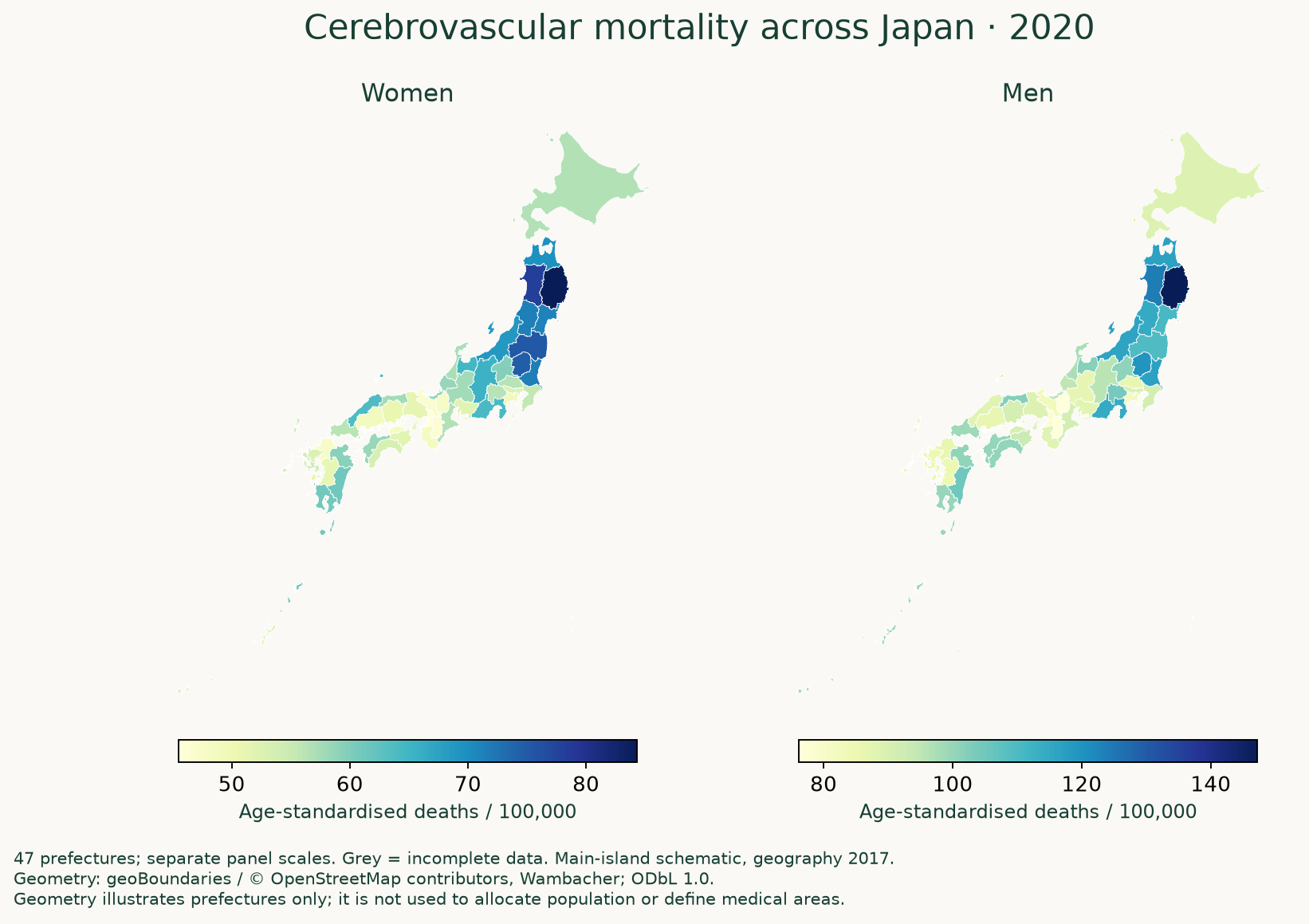
Japan’s stroke-related death rates are higher in more rural prefectures.
The pattern appears in both women and men after accounting for differences in age structure. It raises questions about how local services connect ageing communities with regional care.
THREE THINGS TO KNOW
What we found.
The rural pattern appears in women and men.
The most-rural group has higher average death rates from cerebrovascular diseases—conditions affecting blood vessels in the brain, including stroke—than the least-rural group. The comparison accounts for differences in age structure.
Different heart and blood-vessel diseases tell different stories.
The rural pattern does not apply uniformly to every cardiovascular condition. Among women, deaths from ischaemic heart disease show the opposite pattern. A single headline about all heart disease would hide that difference.
Ageing communities need connections to regional care.
Areas combining greater rurality and older populations have more residents aged 75+ per registered main-specialty cardiologist. Separately, patient-flow records show that hospital care often crosses medical-area boundaries. Neither measure alone establishes an access problem.
One country. Different patterns of cerebrovascular mortality.
WHY IT MATTERS
The people behind the pattern.
Where people live can shape the questions that services need to answer: how to reach specialist care, arrange rehabilitation and keep follow-up connected to local teams. The data help frame those questions without explaining their causes.
WHAT WE CAN SAY
A finding. A clear limit.
The percentages compare averages of prefectural rates, not individual risk or pooled national rates. Mortality data cover all ages and do not describe only people aged 75+. The study does not establish that rurality or specialist numbers caused the differences.
THE NEXT QUESTION
Turn the finding into a better question.
Investigate how local care and regional specialists work together. Test referral completion, travel burden, rehabilitation and follow-up before claiming that a new network improves outcomes.
GO DEEPER
Clear findings. Open evidence.
We connected official mortality, population, rural classification, workforce and patient-flow sources. Prefectures are Japan’s regional administrative areas; smaller medical areas describe care networks. The sources cover different years, and patient flows are analysed separately rather than turned into a local access score.
Explore the full scientific record.
The technical report explains the sources, definitions, statistical methods, uncertainty and limitations. It retains the detailed results, including weaker findings and comparisons that do not support a clear difference.
The downloaded HTML includes its figures. Existing data, dictionaries and checks are preserved in the evidence package. The report states the limits of reproducibility.
Cite the evidence.
The Smart Mole Institute. Rural context, age-standardised cerebrovascular mortality, ageing and care networks in Japan. JP001. Technical report version 1.1, editorial restructuring 2026-10-20. Original publication 2026-10-19. Underlying analyses unchanged; exploratory; not peer reviewed.
Download citation · TXTCONTINUE THE CONVERSATION
What should we investigate next?
Suggest a question, share local context or help us improve the research.
Contact the Institute ↗